
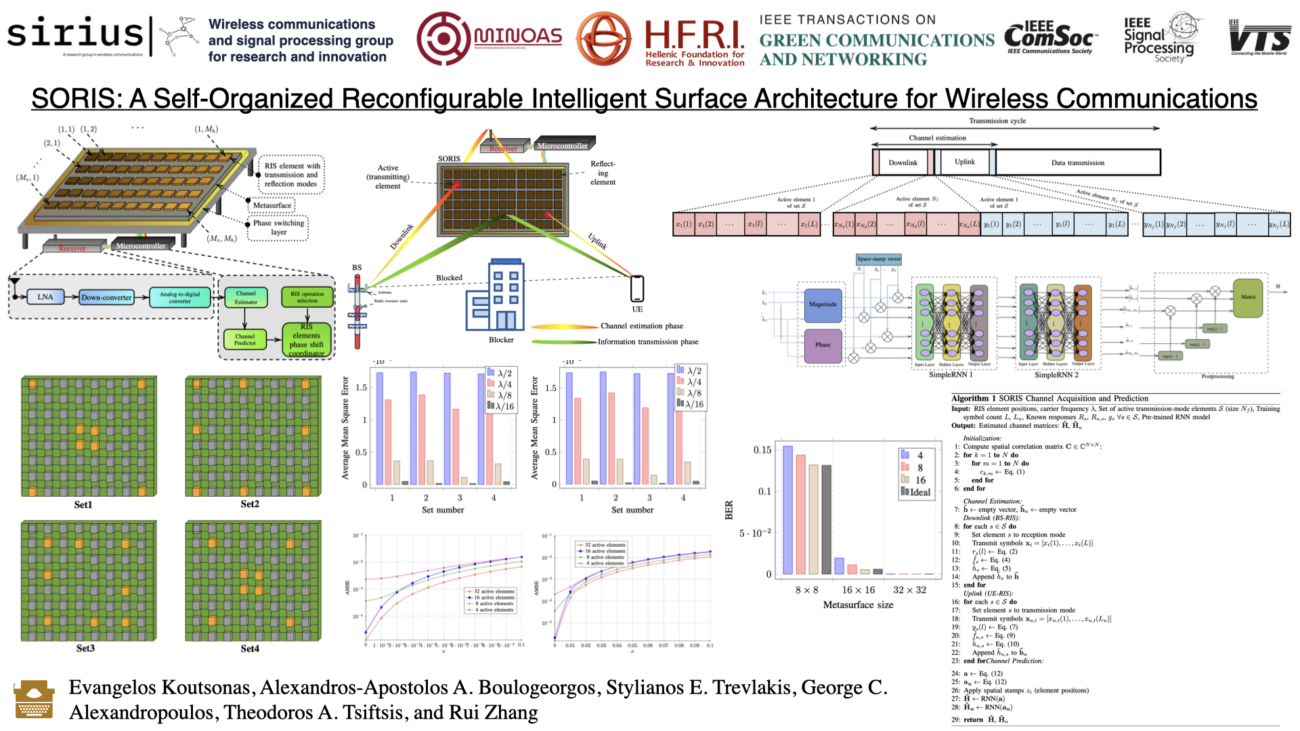
SORIS_2.001

Paper Accepted!

📢 Paper Accepted! 📢


I’m pleased to share that our paper
“SORIS: A Self-Organized Reconfigurable Intelligent Surface Architecture for Wireless Communications”
has been accepted for publication in IEEE Transactions on Green Communications and Networking.

👥 Authors:
Evangelos Koutsonas, Alexandros-Apostolos A. Boulogeorgos, Stylianos E. Trevlakis, George Alexandropoulos, Theodoros Tsiftsis, and Rui Zhang

🧠 What is it about?
In this work, we propose SORIS, a novel self-organized reconfigurable intelligent surface (RIS) hardware architecture that enables autonomous channel estimation and configuration without requiring dedicated links to the transmitter or receiver. By combining:
đź«´ a microcontroller-enabled RIS architecture,
đź«´ low-latency channel estimation using a small subset of transmitting RIS elements, and
🫴 a low-complexity machine learning framework that exploits spatial channel correlation,
SORIS can efficiently acquire channel state information and dynamically reconfigure itself to assist wireless communications. We also provide a detailed complexity, wiring density, and control signaling analysis, and validate the feasibility and performance of the proposed design through Monte Carlo simulations.

🌱 This work contributes to the development of energy-efficient, scalable, and intelligent RIS-assisted wireless systems, aligning with the vision of green and sustainable communications.

🙏 Acknowledgment
This work was supported by the research Project-MINOAS. The project is implemented in the framework of the H.F.R.I. call “Basic Research Financing (Horizontal Support of All Sciences)” under the National Recovery and Resilience Plan “Greece 2.0”, funded by the European Union – NextGenerationEU (H.F.R.I. Project Number: 15857).

đź”— Looking forward to sharing more details soon and discussing future research directions!

RIS hashtagWirelessCommunications hashtagMachineLearning hashtagGreenCommunications

Holographic mmWave Metasurface Integrating THz Sensing for 6G Wireless Networks

🚀 New Research Alert!

We’re excited to share our latest paper:
“Holographic mmWave Metasurface Integrating THz Sensing for 6G Wireless Networks”

🔍 Why does it matter?

As 6G networks evolve, integrating high-data-rate communication (mmWave) and high-resolution sensing (THz) into a unified system is critical—yet challenged by electromagnetic interference. Our work introduces a novel holographic metasurface architecture that bridges mmWave communication and graphene-based THz sensing, paving the way for robust, scalable ISAC (Integrated Sensing and Communication) systems.


✨ Key highlights:
âś” Simultaneous mmWave communication + THz sensing for 6G smart environments.
âś” Innovative design to mitigate EM interference between functions.
âś” Discussion of real-world applications, challenges, and pathways to commercial viability.


📄 Abstract snippet:
*”Holographic metasurfaces have emerged as pivotal for 6G, but unifying sensing/communication hardware remains a challenge. We propose an integrated THz-mmWave system with graphene antennas, addressing interference while enhancing performance.”*
đź”— https://ieeexplore.ieee.org/document/11095325


💬 Thoughts? Let’s discuss how this could shape future networks! hashtag6G hashtagMetasurfaces hashtagTHz hashtagmmWave hashtagISAC hashtagWirelessCommunication

graphAbstract

Article accepted for publication

Some great news! Our article “Holographic mmWave Metasurface Integrating THz Sensing for 6G Wireless Networks” was accepted for publication in IEEE Wireless Communications. The paper was authored by Hamidreza Taghvaee, Alexandros Pitilakis, Maryam Khodadadi, Odysseas Tsilipakos, Alexandros-Apostolos A. Boulogeorgos, and Mohsen Khalily!

Abstract: Holographic metasurfaces have emerged as a pivotal technology in advancing sixth-generation (6G) networks, facilitating smart environments that manipulate electromagnetic (EM) waves to enhance signal coverage and robustness. High data rate communication and high-resolution sensing are essential for 6G wireless networks. Yet, developing a unified hardware system that integrates communication and sensing (ISAC) at these standards remains a formidable challenge. A critical issue is the EM interference between the sensing and communication signals, which can undermine both the effectiveness and reliability of the system. This paper introduces a novel architectural approach for holographic metasurfaces which operate across mmWave for communication and integrate THz graphene antennas for sensing, crucial for the deployment of future 6G networks. We outline potential applications of this integrated THz-mmWave system and discuss various challenges and considerations essential for its effective implementation and commercial viability, aiming to ensure robust, efficient, and scalable network performance.