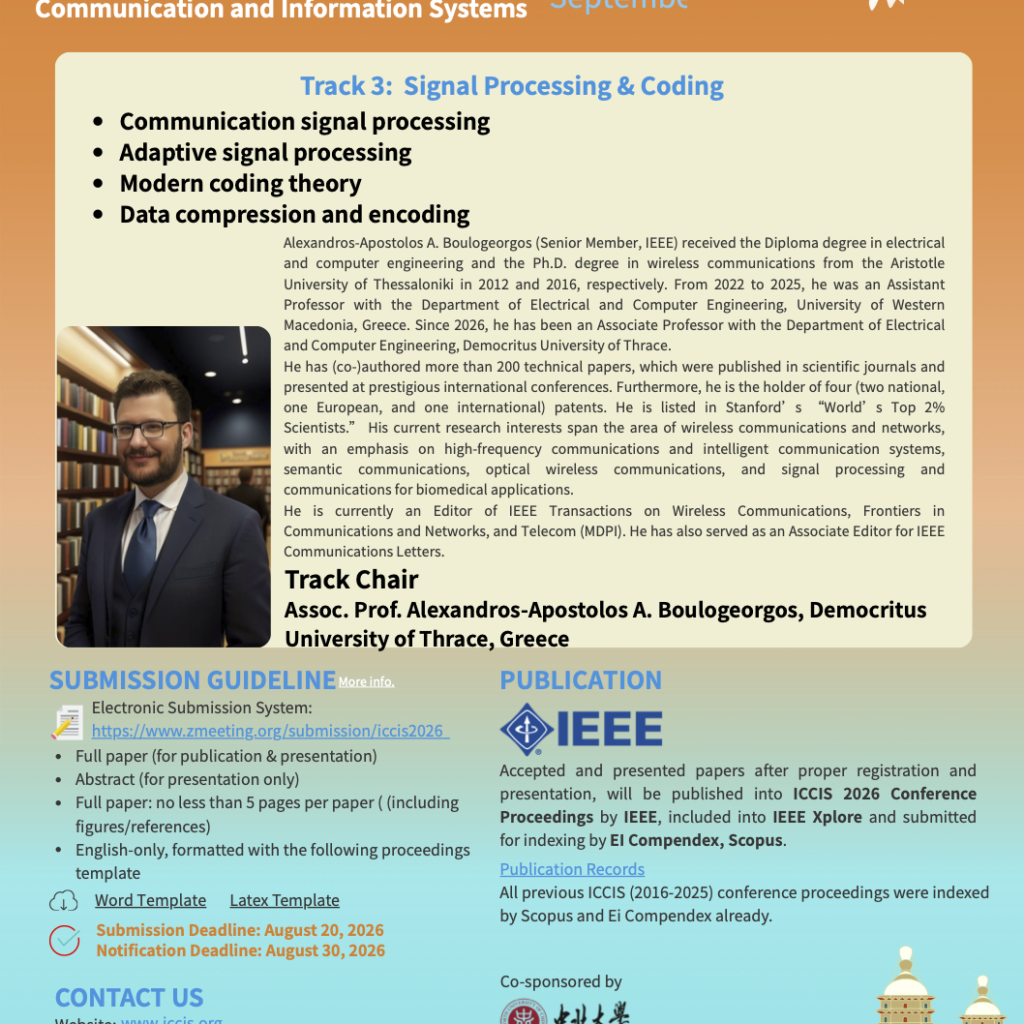
. What does the future of signal processing and coding look like? SIRIUS is proud to highlight Track 3: Signal Processing & Coding at ICCIS 2026, the 10th International Conference on Communication and Information Systems, taking place September 19–21, 2026 in Taiyuan, China.
The track is chaired by Assoc. Prof. Alexandros-Apostolos A. Boulogeorgos of Democritus University of Thrace, a Senior IEEE Member and Stanford-listed Top 2% Scientist with over 200 published works and four patents spanning wireless communications, semantic communications, and biomedical signal processing.
The track welcomes contributions across key research areas shaping next-generation communication systems:
 Communication and adaptive signal processing
Modern coding theory
Data compression and encoding
Accepted papers will be published in the ICCIS 2026 proceedings by IEEE and submitted for indexing in IEEE Xplore, EI Compendex, and Scopus. Submissions are open via the official portal, with a deadline of August 20, 2026. Explore the full call for papers and submission guidelines at www.iccis.org.